As artificial intelligence and social media reshape how students evaluate information, teaching about genocide and mass atrocities has grown more complex.
Teachers in Michigan are required to spend at least six hours on genocide curriculum during grades 8-12. They must navigate not only changing technology but also shifting geopolitical events and a generation of students who see the world differently than those before them.
At Michigan State University, a yearlong fellowship program is helping educators statewide meet these challenges.

Now in its third cohort, MSU’s Holocaust and Genocide Curriculum Teacher Fellowship brings Michigan educators together to explore new approaches to teaching history’s most difficult subjects, equipping them to build critical thinking and media literacy skills in their students.
The fellowship is supported by John Cillag and Eva Gero Cillag, who are passionate about Holocaust education and education for democratic citizenship. John Cillag graduated from MSU in 1962 with a degree in Mechanical Engineering.
“During the program, participants design innovations in their curriculum to address challenges they are encountering in their classrooms as they teach about these different historical and contemporary events.”
Laura Yares, Associate Professor of Religious Studies
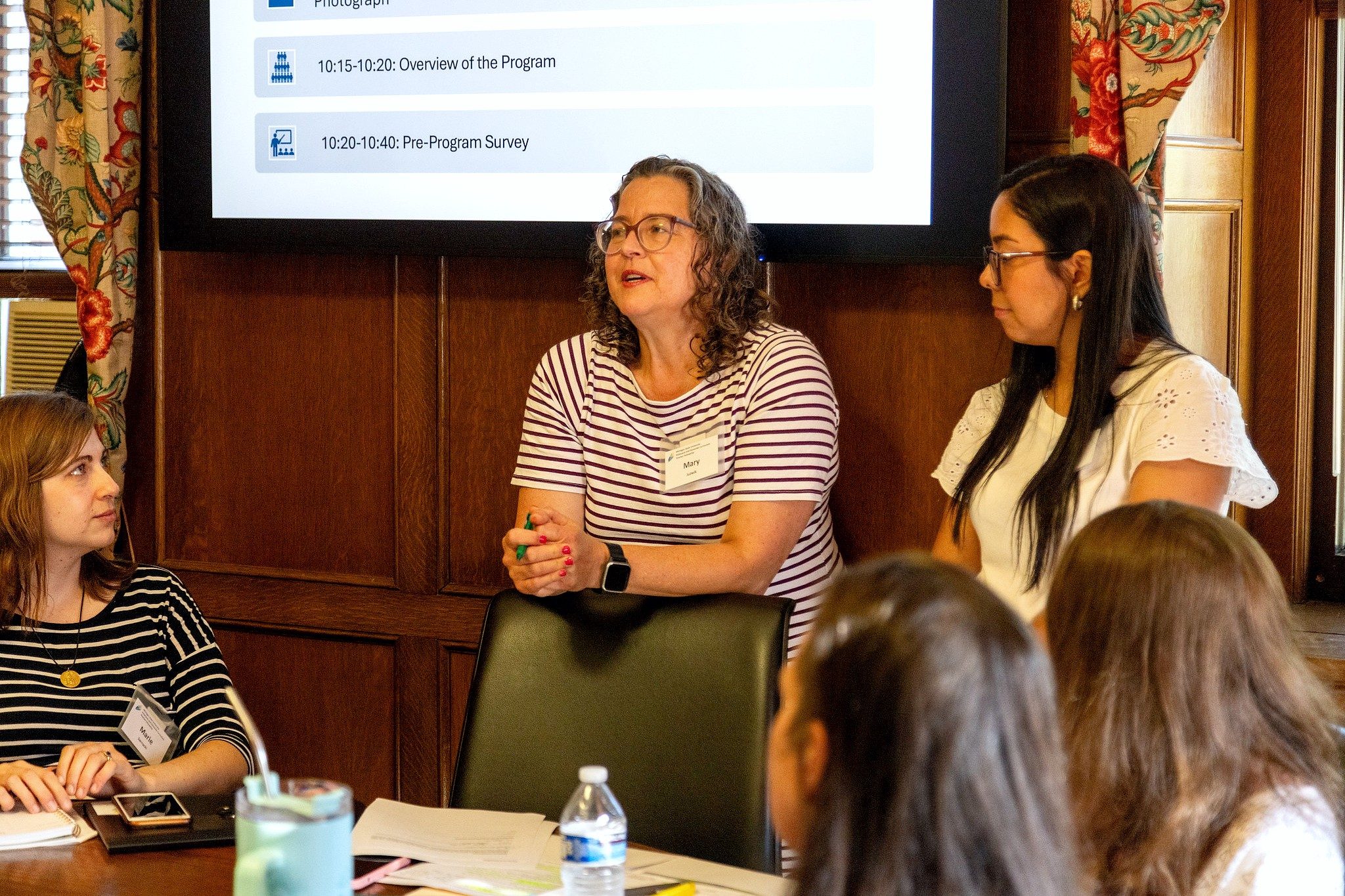
The fellowship is led by Mary Juzwik, Professor of Teacher Education and English; Laura Yares, Associate Professor of Religious Studies; and Deborah Margolis , MSU Librarian for Jewish, Muslim, Middle East, and Religious Studies. The program stands apart from other genocide teacher training programs by integrating methods from the humanities, art, and religious studies; by emphasizing the contemporary cultural contexts in which Gen Alpha students are learning; and by taking a “teachers teaching teachers” approach that positions teachers as experts in their classrooms and communities. The program invites teacher inquiry around four themes cutting across genocide — dehumanization, group identity, testimony, and memory — while emphasizing resilience, culture, and human flourishing.

“Genocide crosses multiple cultural and historical contexts, and we want to give teachers touchpoints across those experiences,” Yares said. “During the program, participants design innovations in their curriculum to address challenges they are encountering in their classrooms as they teach about these different historical and contemporary events.”
Learning from Scholars and Each Other
The Holocaust and Genocide Curriculum Teacher Fellowship begins with a four-day intensive workshop on MSU’s campus in early August. During the workshop, 10 full-time educators and 10 MSU teacher candidates attend sessions led by MSU scholars, including Yares, Juzwik, and Margolis. The sessions include hands-on activities, lectures, and group discussions focused on defining genocide, Jewish experiences during the Holocaust, cross-cultural genocides, and teaching genocide to generations Z and Alpha.
“I really wanted to learn more about this difficult subject matter that I could bring back to my students and teach them how to see the world a little differently and be more empathetic,” said Bailey Rothe, a social studies teacher at Regina High School, an all-girls Catholic school in Warren. “A lot of students like to find quick and easy answers, and talking about something like genocide, there are often no quick and easy answers. By going through this content with my students, they can learn to think about things more deeply.”



Nick Sitts, a social studies teacher at Cadillac Senior High School, teaches a course focused on genocide. He said the class is especially important in an area like Northern Lower Michigan, where the culture is more homogeneous than in an area like metro Detroit.
“By introducing these concepts, you’re teaching what’s called historical empathy: that there are problems that exist for a variety of people outside your demographic, and you need to be conscious of their stories, what their people have gone through, so you can be more open to wider problems in society as a whole and connect with people in the present day,” he said. “By learning more about these topics, I can bring back new ideas and knowledge and give my students the best possible education.”
“The teachers in the first three years of the program especially appreciate the opportunity to learn from and with each other, and to have that space to reflect on how they might do things differently.”
Mary Juzwik, Professor of Teacher Education and English
Juzwik highlights how “More than just giving them resources, we’re creating a space for dialogue where teachers can percolate ideas. The teachers in the first three years of the program especially appreciate the opportunity to learn from and with each other, and to have that space to reflect on how they might do things differently.”
During the summer intensive, this model is intergenerational, with teachers currently leading classroom learning alongside teacher candidates — MSU students who are preparing for careers as teachers.

“We’re learning from each other: Current teachers bring real classroom experience, preservice teachers bring new perspectives, and it creates this intergenerational dialogue,” said Ryan Saeed, an incoming fourth-year history teaching candidate at MSU. “Sometimes one of us brings something up, and a teacher with years of experience says, ‘Oh yeah, I can tell you exactly how — we have the lived experience.’ And vice versa: Myself and other preservice teachers are closer to remembering when we first learned about the Holocaust in a school setting and can offer thoughts on it.”
Turning Learning Into Classroom Practice
The learning continues beyond the summer sessions. The 10 full-time educators selected for the fellowship reconvene monthly throughout the academic year, working together and with Juzwik, Margolis, and Yares on “inquiry projects” — new curriculum interventions designed for their own classrooms.
Margolis works closely with participants as they research and develop their inquiry projects, helping them identify important primary source materials, relevant academic literature, and other teachable materials.


“They’re diving into what’s already been done and thinking about how they can contribute something new,” she said.
Roselea Mann, an MSU alum, is a social studies teacher at Haslett High School who was part of the Holocaust and Genocide Curriculum Fellowship’s second cohort in 2025. As a result of her inquiry project, she readjusted her approach to teaching world history.
“Through the inquiry project, we were encouraged to find a problem of practice within our classrooms, and we were given the resources, space, and encouragement to bring meaningful Holocaust and genocide education into our teaching,” she said. “I actually reframed my entire second semester, which sounds like a lot, but since my course is already 20th-century world history, I just moved things around to teach world history through the context of conflict, genocide, and change. So rather than a separate genocide unit, [this content is now] intertwined with everything else we’re teaching.”
“They’re diving into what’s already been done and thinking about how they can contribute something new.”
Deborah Margolis, MSU Librarian for Jewish, Muslim, Middle East, and Religious Studies
The impact extends well beyond individual classrooms. As part of the fellowship, participants share what they’ve developed by leading sessions with colleagues in their districts and at conferences, expanding the program’s reach across the state. Past participants often return to present to current fellowship participants, as Mann did this summer, sharing her experience using online resources from Centropa, a nonprofit dedicated to preserving Jewish memory in Central and Eastern Europe, the Balkans, the Baltics, and the former Soviet Union, as a tool in her classroom.
“Anytime that you have the ability to get together with other professionals and learn from experts in the field, it’s really meaningful,” Mann said.
Growing Impact Across Michigan

Now with two cohorts completed, the fellowship continues to grow. Applicant interest has more than tripled since the first cohort, and participating districts span the state — from Detroit to Grand Rapids to rural communities in the northern part of the state — reflecting MSU’s land-grant mission to serve every corner of Michigan.
“The fact that MSU offers this, and not many other places do, is very telling,” Sitts said. “It’s a story that needs to be told by more people, so taking part in this program is an honor. Hopefully every university sees this and expands upon it.”
Brandi Bates, a social studies teacher at Clarkston Junior High and an MSU alum, said the program reaffirmed her sense of the university’s reach.
“The fact that MSU offers this, and not many other places do, is very telling. It’s a story that needs to be told by more people, so taking part in this program is an honor.”
Nick Sitts, Social Studies Teacher at Cadillac Senior High School
“It further justifies my decision as an undergrad to come here,” she said. “It feels like the community is pouring back into the state for opportunities. The university is making it clear this isn’t just for Michigan State, there are other people here too.”
That sense of community is central to the fellowship’s mission: bringing educators together to learn from one another while giving them the support and resources to take that learning back to their classrooms.

“We’re not just bringing teachers here to listen to us share information and teaching tips,” Yares said. “We are seeking to foster a community where teachers feel respected, supported, and better equipped to teach challenging material with care and clarity because of what they learn from us and from each other.
“We’re proud of the community we’ve built,” she added. “It’s a group of people committed to the dignity of human flourishing and to helping the next generation understand what’s at stake.”
The Holocaust and Genocide Curriculum Teacher Fellowship was featured on WKAR’s “All Things Considered” radio program in a story that aired Aug. 12, 2026, titled “Michigan teachers grapple with AI in the classroom, whether to work with or without it.”
Applications for the next fellowship cohort open in January 2027. More information is available on the MSU Holocaust and Genocide Curriculum Teacher Fellowship web page.
By Alex Tekip and Kim Popiolek and originally published by MSU Today
Media Contact: Mark Bullion


