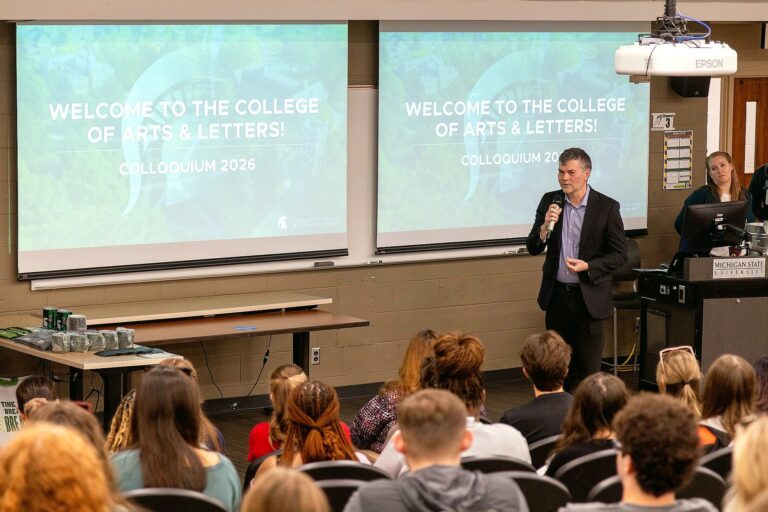
The Farmscapes to Forests: Kellogg Biological Station Long-Term Ecological Research Artists-in-Residence Program is entering its fifth year, featuring Kalamazoo-based visual artist Ellen VanderMyde as the 2026 Artist-in-Residence and the debut of the program’s first group exhibition showcasing the work of last year’s cohort of Michigan State University College of Arts & Letters artists.

Launched in 2022 and supported by the National Science Foundation to promote collaborations between art and science, the program offers artists working in any medium a one-week immersion during the summer at MSU’s W.K. Kellogg Biological Station (KBS) in Hickory Corners, Michigan, where they collaborate with scientists, students, and educators connected by a shared passion for observing and exploring the natural world.
For each Artist-in-Residence, they are given the opportunity to return to KBS throughout the summer, if desired. The program then culminates with a return visit and public exhibition when the artist-in-residence share their work and experience with the KBS community.
Five Years of Growth
The artist-in-residence program was founded by Gretel Van Wieren, Professor in the Department of Religious Studies at MSU, in collaboration with Elizabeth Schultheis, Education and Outreach Coordinator for the Long-Term Ecological Research (LTER) program at KBS, and Nameer Baker, KBS LTER Science Coordinator. The program, which began as a single annual residency, has grown into a cohort model that connects multiple artists with the scientific community at KBS each year.
“What began as a pipe dream around a dinner table at a KBS LTER event has blossomed into a thriving program that has enriched both artistic and scientific communities.”
Dr. Gretel Van Wieren
“The past five years have been an amazing period of growth for the Farmscapes to Forests Artist-in-Residence program,” Van Wieren said. “What began as a pipe dream around a dinner table at a KBS LTER event has blossomed into a thriving program that has enriched both artistic and scientific communities and has helped illuminate how different ways of knowing about particular landscapes may mutually work to strengthen and sustain people’s relationship to the land.”


That growth will be represented this year with the program’s first-ever group exhibition, bringing together the three MSU College of Arts & Letters artists who served as 2025 Artists-in-Residence:
- Liv Furman is an Assistant Professor in MSU’s Department of African American and African Studies and an Assistant Project Director of the Quilt Index’s Black Diaspora Quilt History Project at MSU. Furman’s primary mediums include multimedia and digital collage, ceramics, quilting, and the written and spoken word.
- Blaire Morseau is an Assistant Professor and 1855 Professor of Great Lakes Anishinaabe Knowledge, Spiritualities, and Cultural Practices in MSU’s Department of Religious Studies and an affiliate faculty in American Indian and Indigenous Studies. A citizen of the Pokagon Band of Potawatomi Indians, Morseau is a beadwork artist.
- Mikayla Thompson is a poet with Cherokee Nation descent who graduated from MSU in December 2023 with a B.A. in Linguistics and a minor in Indigenous Studies from Michigan State University. She is a Professional Aide for the American Indian and Indigenous Studies program and the Beal Botanical Garden.
The exhibition is scheduled for July 17, 2026, from 4 to 7 p.m. at the W.K. Kellogg Bird Sanctuary.
“Having the opportunity this year to host a cohort of artists from diverse backgrounds and working in various mediums has shown how important it is to engage a plurality of artistic modes of engaging with long-term ecological research in order to broaden public awareness about shifting ecosystem dynamics,” Van Wieren said.
2026 Artist-in-Residence: Ellen VanderMyde

VanderMyde is a visual artist, muralist, and teaching artist. Her residency at KBS runs May 24-31, 2026.
Over the past 15 years, VanderMyde has built a career as a visual artist and shown her work regionally and nationally. A Kalamazoo Promise alum, she received her B.A. in Fine Art with a minor in Art History from the Frostic School of Art at Western Michigan University. She has been awarded artist residencies with Stay Home Gallery and the Kalamazoo Institute of Arts. She also is a Kalamazoo Artistic Development Initiative (KADI) grant recipient.
“I’m very excited to be the KBS LTER Farmscapes to Forests Artist-in-Residence for 2026-2027,” VanderMyde said. “I’m looking forward to touring the station and meeting with scientists and students to learn about their research.”
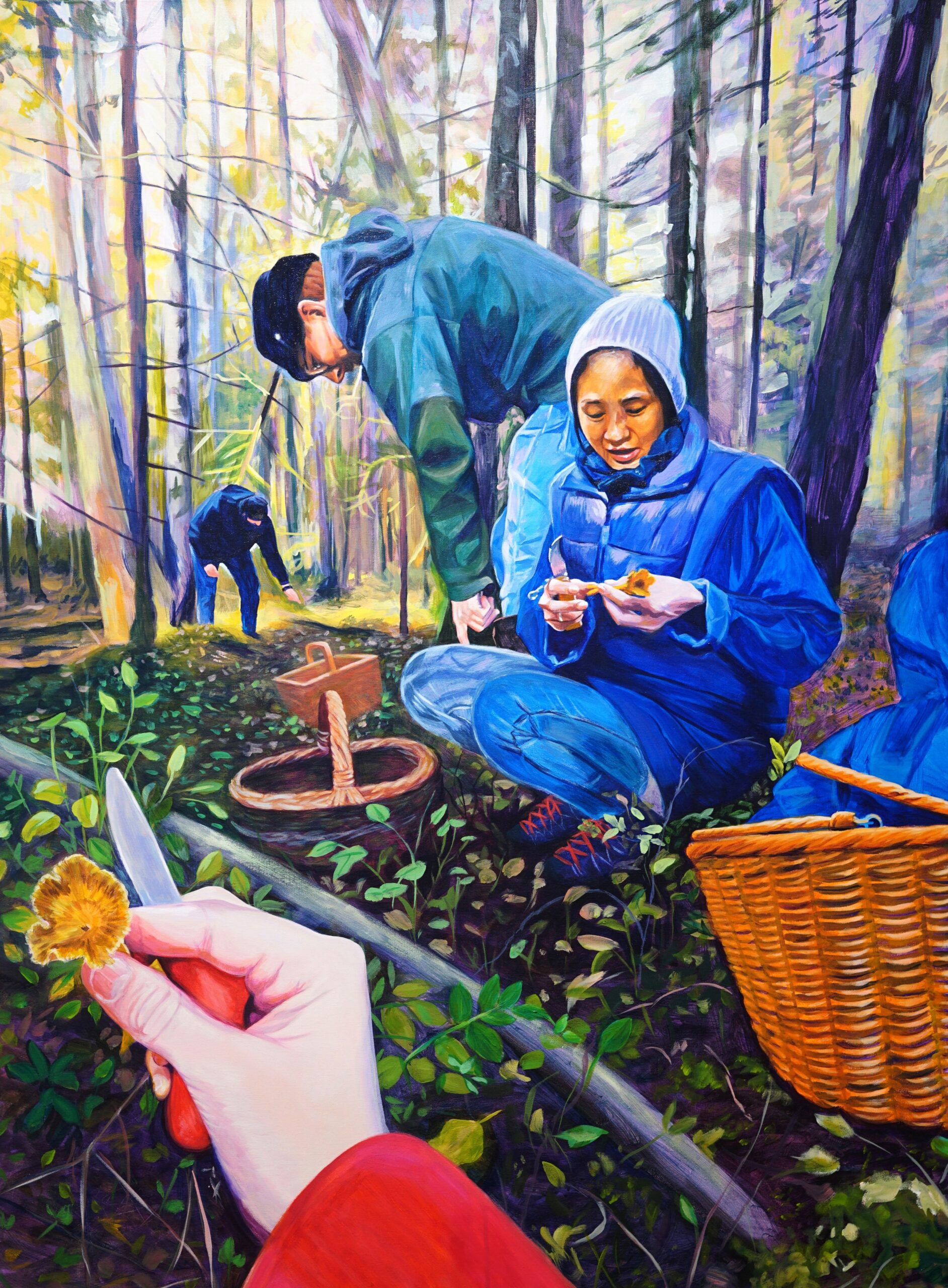
During her time at KBS, VanderMyde will visit researchers in the field and participate in lab activities and observation to create a series of paintings featuring KBS scientists and students interacting with the natural world.
“My hope is that through the observation of fieldwork and one-on-one interviews, the paintings I create will provide a unique perspective into the relationships between environmental scientists, the land, and the nonhuman inhabitants they study,” she said. “By depicting people who have devoted their life’s work to understanding and protecting their local ecology, the work will illuminate how that connection and relationship can be fostered.”
Humanizing the Science
Before leading the program at MSU, Van Wieren worked at other LTER sites, which is what inspired her to establish an artist-in-residence program at KBS. Van Wieren was the 2022 Artist-in-Residence at the Cedar Creek Ecosystem Science Reserve LTER at the University of Minnesota and the 2015 Writer-in-Residence at the H.J. Andrews Experimental Forest LTER at Oregon State University.
“This program helps humanize the science and expand the public reach of the long-term ecological research that’s happening at these places.”
Dr. Gretel Van Wieren
While Van Wieren says she sees the real value of science and art collaborations like these in providing the broader community with access to what at times is impenetrable in terms of scientific research.

“This program helps humanize the science and expand the public reach of the long-term ecological research that’s happening at these places,” she said. “Another value is the building of community at the bio stations. Artists interact with scientists, and scientists see their work or themselves in new ways that may generate new insights. It’s been exciting and gratifying to see how focusing on art at KBS has sparked a lot of interest, not only from researchers but from students. There’s a real interest to make these bridges between arts and humanities with environmental and biological science.”
Looking ahead, Van Wieren hopes to continue developing a network of artists and humanities scholars, creating a community of practice that elevates the unique scientific research conducted at the KBS LTER while helping to deepen people’s sense of connection to and care for the local land community.
By Austin Curtis and Kim Popiolek