Students in a Religious Studies 101 class at Michigan State University are seeing their coursework reach a public audience. Projects created in the class taught by Nareman Amin, Assistant Professor of Religious Studies, are currently available for display in the 360 Room of the MSU Libraries Digital Scholarship Lab. The immersive presentations draw on materials from the MSU Libraries’ Special Collections and related primary sources, inviting visitors to engage with the students’ research in an interactive setting.

The projects were developed during a Fall 2025 section of REL 101, an introductory course in the Department of Religious Studies, that Amin taught for the first time. Inspired by the Collecting Religion Lecture Series, Amin designed the assignment to encourage students to work directly with primary materials and to present their findings in a creative, public-facing format.
“REL 101 is meant to introduce students to a variety of religious and spiritual beliefs and practices, from the prehistoric era to today,” Amin said. “Among the main aims of the course is helping students learn about and respect the viewpoints of others, even if they disagree on fundamental issues like personal belief and ways of life. We don’t need to agree with each other, but we should respect these differences and develop a sense of empathy.”

The Collecting Religion Lecture Series, a collaboration between the Department of Religious Studies and MSU Libraries that was held during the Spring 2025 Semester, highlighted how faculty research and teaching intersect, using rare and historical materials housed in the Murray and Hong Special Collections.
As part of this series, Religious Studies faculty delivered lectures demonstrating how primary sources inform their scholarship. Amin attended these lectures, which inspired the project she later developed for her students.
“The lectures were engaging, and seeing the materials, some dating back hundreds of years, right in front of us felt like walking into a very well-informed museum exhibit,” she said. “I wanted students to have a similar experience.”
Amin designed the assignment around three core goals: introducing students to the library’s resources, helping them develop expertise in a specific topic, and encouraging them to share their knowledge in a compelling, public-facing way.
“This felt far more effective than term papers or exams that I alone would read to assign a grade and no one else would benefit from. I also hoped it would be a memorable experience for the students.”
Nareman Amin, Assistant Professor of Religious Studies
“This felt far more effective than term papers or exams that I alone would read to assign a grade and no one else would benefit from,” Amin said. “I also hoped it would be a memorable experience for the students.”
Another key motivation behind the assignment was Amin’s interest in addressing the impact of artificial intelligence on student learning.
“To mitigate the effects of AI on student engagement with course materials and its potential to dampen creativity,” she said, “I wanted to collaborate with our wonderful librarians to create an experiential assignment that students could feel invested in and be less inclined to cut corners.”
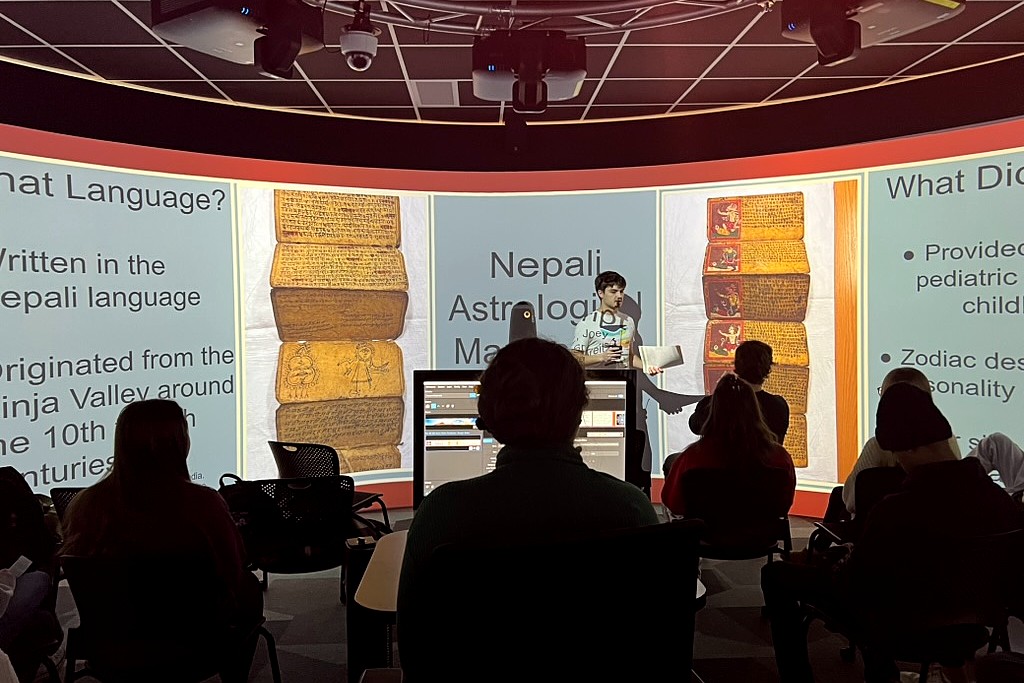

Working in small groups, students selected materials connected to religious traditions studied in the course. Some focused on objects from MSU Libraries Special Collections, while others examined broader artistic and religious traditions through primary-source research. The materials spanned a wide historical range, from 18th- and 19th-century works to publications as recent as 2019.
“In their evaluations, some students shared that they really enjoyed diving deeply into a single religious tradition rather than memorizing facts for an exam,” Amin said. “Each group approached their materials differently, and it was exciting to see that difference. We also had an interesting conversation about the repatriation of materials versus preservation in institutions like ours.”
The final projects were created for display in the 360 Room, an immersive digital space that allows viewers to experience visually and acoustically rich presentations.
“The projects are really visually striking,” Amin said. “Students captured core teachings of their chosen traditions while offering thoughtful context about the materials’ significance and relevance to the course. They got really creative.”
Buddhism Through Food
For first-year student Emmet Ewing, a Data Science and Zoology major who expects to graduate in 2029, the project offered an opportunity to explore Buddhism through the lens of food.
“The object my project focused on was a 2019 cookbook written by a renowned temple chef, detailing many vegetarian recipes,” Ewing said. “The book is written in English and explains how these recipes play a role in Buddhist tradition by describing their spiritual significance.”

The cookbook, Wookwan’s Korean Temple Food, is a concrete example of how religious values are embedded into everyday practices.
“The most rewarding part of this project was reading how Buddhist practices influence most of their life. For example, vegetarianism represents compassion for living things,” Ewing said. “Before working on this project, I had some understanding of Buddhism, but I didn’t realize the extent to which it shapes people’s lives.”
“Before working on this project, I had some understanding of Buddhism, but I didn’t realize the extent to which it shapes people’s lives.”
Emmet Ewing
Working with a primary source helped Ewing reach a deeper understanding of the abstract concepts discussed in class.
“Engaging with the primary material helped shape my understanding of the religion, as it provided a concrete explanation of something mentioned in class,” he said. “This cookbook provides an example of how food and specific recipes play a role in the Buddhist way of life. The recipes embody Korean Temple food, and the book explains how those recipes embody principles in Buddhism.”
Art, Sound, and Cultural Context
Other projects explored how religious meaning is conveyed through art and media. Aiden Kalisz, a senior majoring in Games and Interactive Media with a specialization in Sound Design, focused on artistic representations of the Stations of the Cross.
“My project didn’t focus on materials from Special Collections per se,” Kalisz said, “but rather on artistic representations of the Stations of the Cross throughout history and the context behind those works.”
For Kalisz, the most compelling aspect of the research was uncovering the stories behind the works themselves.
“The sources I studied gave me a better understanding of how religion is viewed artistically in different cultures. There were so many styles and interpretations of the same story that it really was a cool way to understand a place’s culture based on the art used.”
Aiden Kalisz
“I found the context behind each piece to be the most rewarding part,” he said. “Each artistic representation had really interesting stories behind them, with many of the artists having unique circumstances that shaped why and how they created their pieces.”
By examining multiple interpretations of the same religious narrative, Kalisz gained insight into how faith is shaped by culture, place, and artistic tradition.
“The sources I studied gave me a better understanding of how religion is viewed artistically in different cultures,” Kalisz said. “There were so many styles and interpretations of the same story that it really was a cool way to understand a place’s culture based on the art used.”
The Role of the 360 Room
The decision to stage the projects in the Digital Scholarship Lab’s 360 Room grew from Amin’s prior teaching experience. In Spring 2025, she used this space to take students in another course on a virtual Islamic pilgrimage, or Hajj.
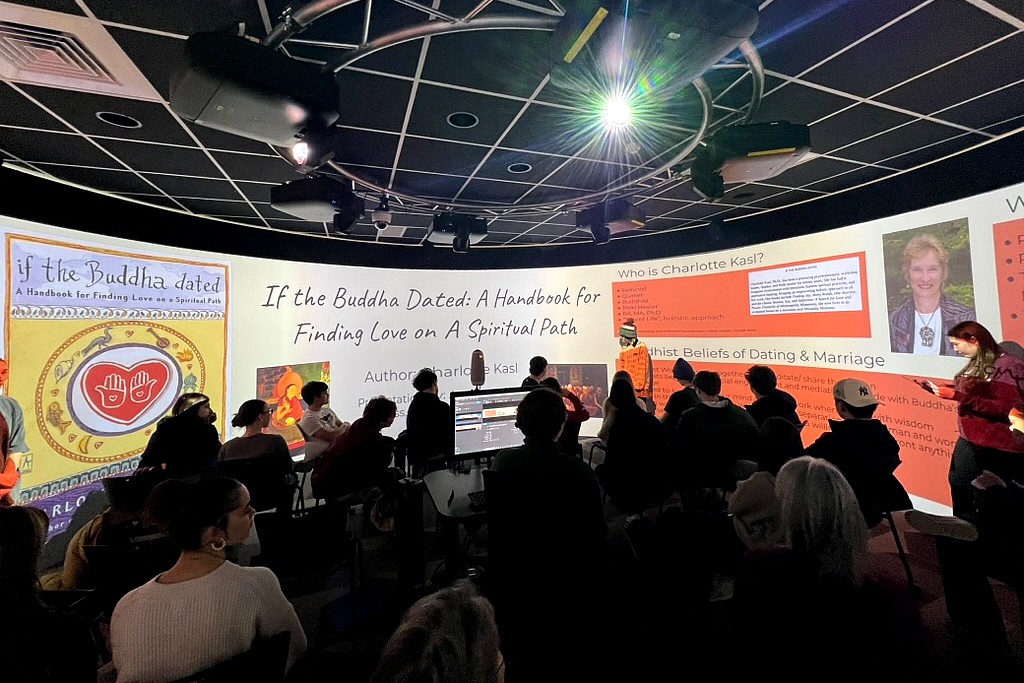
“I really enjoyed the immersive experience, and I think the students did, too,” she said. “Rather than taking in information, I thought why not have students produce knowledge and create presentations of their own to be shown in the 360 Room.”

Amin also views the projects as a form of outreach beyond the classroom. As a College of Arts & Letters Outreach Fellow, she hopes the presentations will introduce prospective students and visitors to MSU’s Libraries’ resources and to the humanities coursework offered by the College of Arts & Letters.
“I hope these presentations can be used in the future to showcase the amazing resources we have at the library and to promote the College of Arts & Letters, especially during Green and White Days,” she said.
Looking ahead, Amin plans to make the project a permanent feature of REL 101 whenever she teaches the course.
“I absolutely intend to do this every year I’m assigned to teach REL 101,” she said. “I am incredibly grateful to the wonderful staff and librarians who made this possible. Shout-out to Mariah Allum, Tad Boehmer, Paul Cooper Jr., Deborah Margolis, Eli Wachter, and Justin Wadland.”